Jumeirah Bay Island: How Dubai's Most Exclusively Sculpted Waterfront Became the Emirates' Most Architecturally Rarefied Luxury Address
April 2, 2026 · 16 min read
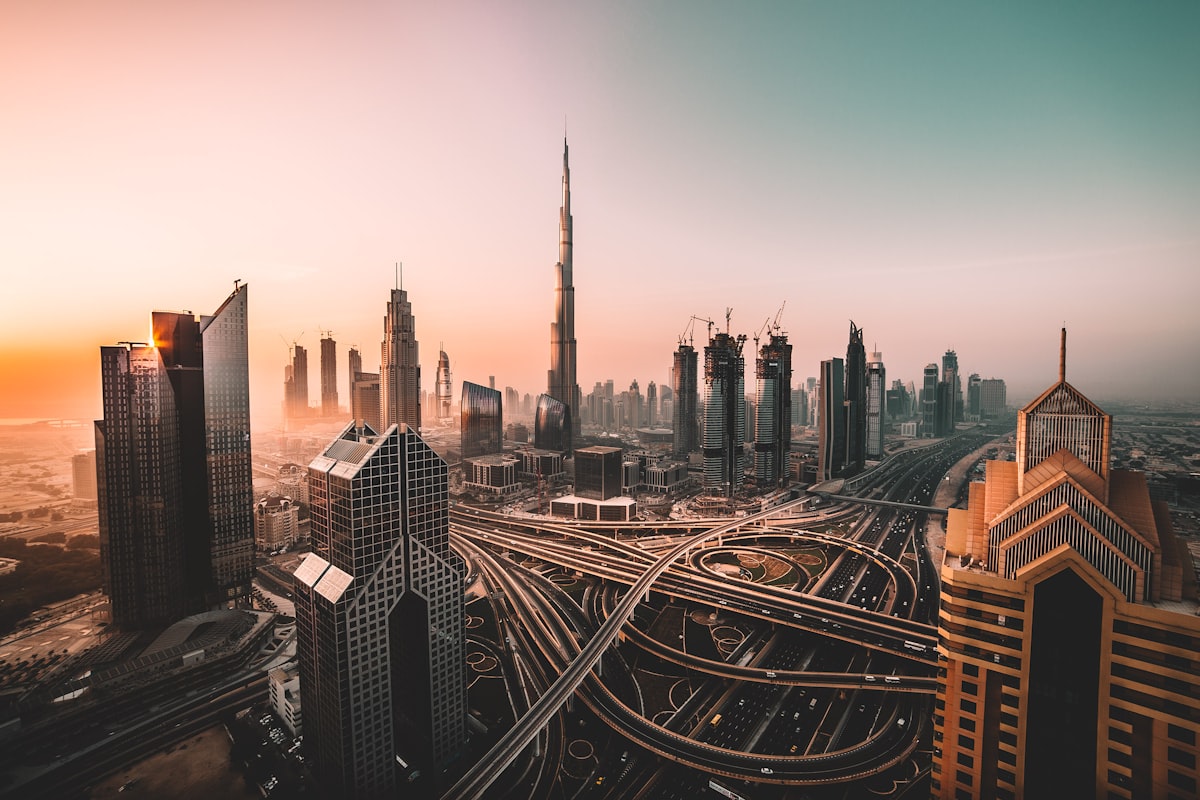
From satellite imagery, Jumeirah Bay Island resolves into the unmistakable silhouette of a seahorse — a 6.3 million square foot crescent of reclaimed land curving into the Persian Gulf approximately 600 metres offshore from the Jumeirah Beach coastline. The zoomorphic design, attributed to Meraas Development's master planning team and executed between 2009 and 2014, is not whimsy; it is spatial engineering optimised for a singular purpose: maximising waterfront exposure per plot. Every one of the island's approximately 170 residential plots commands direct water frontage. There are no interior lots, no second-row positions, no compromised sightlines. In a city that has produced more waterfront real estate per capita than any urban settlement in human history, Jumeirah Bay Island represents perhaps the most efficiently exclusive deployment of coastline ever conceived.
The Bulgari Standard
The island's aesthetic identity was established not by its residential plots but by its anchor tenant. The Bulgari Resort & Residences, occupying the seahorse's head — the most prominent and visible position on the island — opened in December 2017 with 101 hotel rooms, 20 hotel villas, and 165 branded residences. The development was designed by Antonio Citterio Patricia Viel, the Milanese architecture firm that has become LVMH's de facto residential design partner, and its aesthetic — restrained Italian modernism rendered in Mediterranean stone, brushed bronze, and hand-finished concrete — set a tonal benchmark that has influenced every subsequent construction on the island.
The Bulgari effect on Jumeirah Bay Island's market dynamics has been transformative. Before the resort's opening, plots on the island traded at AED 800-1,200 per square foot — respectable but unremarkable by Dubai's prime standards. By 2025, undeveloped plots were commanding AED 3,500-5,000 per square foot, with completed mansions transacting at AED 6,000-9,000 per square foot. The Bulgari Lighthouse — a 24-storey residential tower at the island's western tip offering 49 apartments and 6 penthouses — sold out within forty-eight hours of its private launch in early 2025, with the penthouse achieving a reported AED 410 million. These are figures that place Jumeirah Bay Island not merely among Dubai's most expensive addresses but among the most expensive new-build residential markets on the planet, comparable to London's One Hyde Park, New York's 220 Central Park South, and Hong Kong's Mount Nicholson.
The Architecture of Controlled Individualism
What distinguishes Jumeirah Bay Island from Dubai's other ultra-luxury residential developments — and what explains much of its premium — is its approach to architectural governance. The island operates under a design code administered by Meraas that occupies a precise middle ground between the anarchic heterogeneity of Palm Jumeirah (where Tudor mansions abut glass-and-steel modernist boxes with occasionally surreal results) and the totalitarian uniformity of branded communities like DAMAC Hills or Emaar's Arabian Ranches.
The code specifies material palettes (natural stone, exposed concrete, bronze, timber — no cladding, no curtain wall systems, no painted surfaces), height limits (three storeys plus basement, with exceptions for corner plots), setback requirements, and landscaping minimums. Crucially, it does not specify style. The result is an island where each mansion is architecturally distinct — contemporary Mediterranean adjacent to brutalist-inflected modernism, Japanese-inspired minimalism across the canal from Art Deco revival — yet all participate in a coherent material and scalar language. The effect is akin to walking through a particularly well-curated exhibition of contemporary residential architecture: every house is a statement, but no house is a shout.
Several of the island's completed mansions have been designed by internationally recognised architects. A 40,000 square foot compound by Tadao Ando — his first residential commission in the Gulf — occupies a waterfront plot at the seahorse's upper curve, its signature exposed concrete walls weathering beautifully in the marine climate. Foster + Partners has completed a 35,000 square foot residence whose compound-curved glass walls required the development of bespoke fabrication techniques. And a recently completed 28,000 square foot house by the Lebanese-Brazilian practice Blankpage Architects has been shortlisted for the 2026 Aga Khan Award for Architecture — a distinction that would be the first for a private residence in Dubai.
The Marina and the Superyacht Proposition
Jumeirah Bay Island's private marina, accommodating approximately 130 berths for vessels up to 40 metres, represents a residential amenity that is genuinely rare even by Dubai's standards of infrastructural excess. While Palm Jumeirah offers marina access through the Atlantis-adjacent commercial marina and individual private docks are scattered along the Frond tips, Jumeirah Bay's marina is exclusively available to island residents and Bulgari hotel guests. The waiting list for a permanent berth currently exceeds four years.
The marina's configuration — deep-water access directly to the open Gulf without navigating the confined channels that can make Palm Jumeirah berths challenging for larger vessels — has made it the preferred mooring for a growing fleet of 30-40 metre motor yachts whose owners use them for day trips to the World Islands, Sir Bani Yas, and the Musandam Peninsula. The yacht-to-residence pipeline is a significant driver of purchase decisions: several agents report that buyers' first question is not about the house but about marina availability.
The Demographics of Discretion
Jumeirah Bay Island's buyer profile diverges sharply from that of Dubai's other trophy addresses. While Palm Jumeirah and Downtown attract a cosmopolitan mix of Russian, Chinese, British, and Indian investors — many of whom purchase primarily for rental yield or capital appreciation — Jumeirah Bay's ownership base is dominated by Gulf national families (Emirati, Saudi, Kuwaiti, and Qatari) and a smaller cohort of European industrialists and technology entrepreneurs. The common denominator is not nationality but intent: these are buyers who purchase for personal use, who commission architects rather than accepting developer finishes, and who occupy their properties for significant portions of the year.
The island's security infrastructure reinforces this owner-occupier character. A single vehicular access point connects the island to the mainland via a bridge whose design deliberately restricts throughput — two lanes in each direction, with security checkpoints that process residents via automatic number plate recognition and visitors via pre-registered appointment only. There are no commercial establishments on the island other than the Bulgari resort. No retail, no supermarket, no café, no gym beyond the residents' private club. For daily errands, residents drive five minutes to City Walk or Jumeirah Beach Road. For everything else, there is staff.
This deliberate austerity — the refusal to create a self-contained lifestyle ecosystem — is not a deficiency but a design philosophy. Jumeirah Bay Island does not aspire to be a destination. It aspires to be a retreat: a place from which one emerges into the city and to which one returns, with the crossing of the bridge functioning as a psychological as well as physical transition between public and private life. In a city that relentlessly blurs the boundary between domestic and commercial space — where you can buy a Lamborghini in the lobby of your apartment building and get a facial in the basement — Jumeirah Bay Island's insistence on residential purity is almost countercultural.
The Construction Theatre
As of early 2026, approximately sixty percent of Jumeirah Bay Island's residential plots have been developed, with the remaining forty percent in various stages of construction. The island exists, therefore, in a state of perpetual becoming — a condition that would be considered a nuisance in a mature neighbourhood but that has, on Jumeirah Bay, become a peculiar form of entertainment. Residents speak with genuine enthusiasm about watching their neighbours' houses emerge from the ground, about the succession of international contractors and craftspeople who arrive to execute increasingly ambitious architectural visions, about the crane ballets that unfold against the sunset skyline.
The construction timelines are themselves markers of intent. A typical Jumeirah Bay mansion takes 24-36 months from groundbreaking to completion — two to three times longer than a comparable-scale house in Emirates Hills or Palm Jumeirah. The extended timeline reflects the complexity of the designs, the quality of the finishes (hand-cut stone, custom metalwork, bespoke joinery from Italian and Japanese workshops), and the owners' willingness to accept delay in pursuit of perfection. Contractors report that change orders and mid-construction redesigns are endemic, driven by owners who have visited a hotel in Tokyo or a villa in Sardinia and decided that they need to incorporate a specific detail — a particular stone, a window proportion, a garden wall technique — into their own house.
The Investment Calculus
The investment case for Jumeirah Bay Island rests on absolute scarcity. Unlike Palm Jumeirah, which offers approximately 4,000 residential units across Fronds, Trunk, and Crescent, or Dubai Hills, which will ultimately accommodate over 22,000 units, Jumeirah Bay Island will never contain more than approximately 170 mansions and 380 Bulgari-branded residences. This is not a neighbourhood that can be diluted by new supply. The island is the island; its coastline is fixed; its density is capped. Every property is, in the most literal sense, irreplaceable.
Capital appreciation has reflected this scarcity. A plot purchased from Meraas in 2015 for AED 15 million would today command AED 70-90 million — a compound annual return exceeding 20%. Completed mansions that traded at AED 80-120 million in 2022 are now being marketed at AED 180-300 million, with at least one private transaction in late 2025 reportedly exceeding AED 350 million. These returns are extraordinary even by Dubai's historically volatile standards, and they have been achieved without the speculative froth that characterises much of the emirate's broader property market.
The structural driver is demand from Gulf national families who are, for the first time in Dubai's modern history, choosing to build primary residences on a man-made island rather than in established Emirati neighbourhoods like Jumeirah, Al Wasl, or Zabeel. This demographic shift — driven by a younger generation of Gulf wealth that values architectural expression and waterfront lifestyle over the intergenerational compound model — represents a fundamental reorientation of the region's most patient and substantial capital pool. It is money that enters and does not leave, that builds and does not flip, that appreciates craft and does not cut corners. For the island's long-term value proposition, it is the most favourable buyer base imaginable.
Jumeirah Bay Island is, in the final analysis, Dubai's most sophisticated answer to a question the city has been asking since Sheikh Rashid ordered the dredging of Dubai Creek in 1961: how do you create land that is worth more than the water it displaced? On an island shaped like a seahorse, where every mansion faces the Gulf and the bridge closes behind you like a drawbridge, the answer is simple enough. You create so little of it that the having of it becomes its own credential. You let Bulgari set the tone. You let the architects compete. And you trust that in a city of infinite ambition and finite coastline, the most valuable thing you can own is the one thing that cannot be built again.
Dubai Latitudes · Luxury lifestyle intelligence from Dubai and the Emirates.
← Back to Dubai Latitudes ·
Latitudes Media ·
Monaco Latitudes ·
Riviera Latitudes