Dubai Opera District: How the Desert City's Cultural Quarter Became the Gulf's Most Architecturally Ambitious Performing Arts Destination
March 27, 2026 · 16 min read
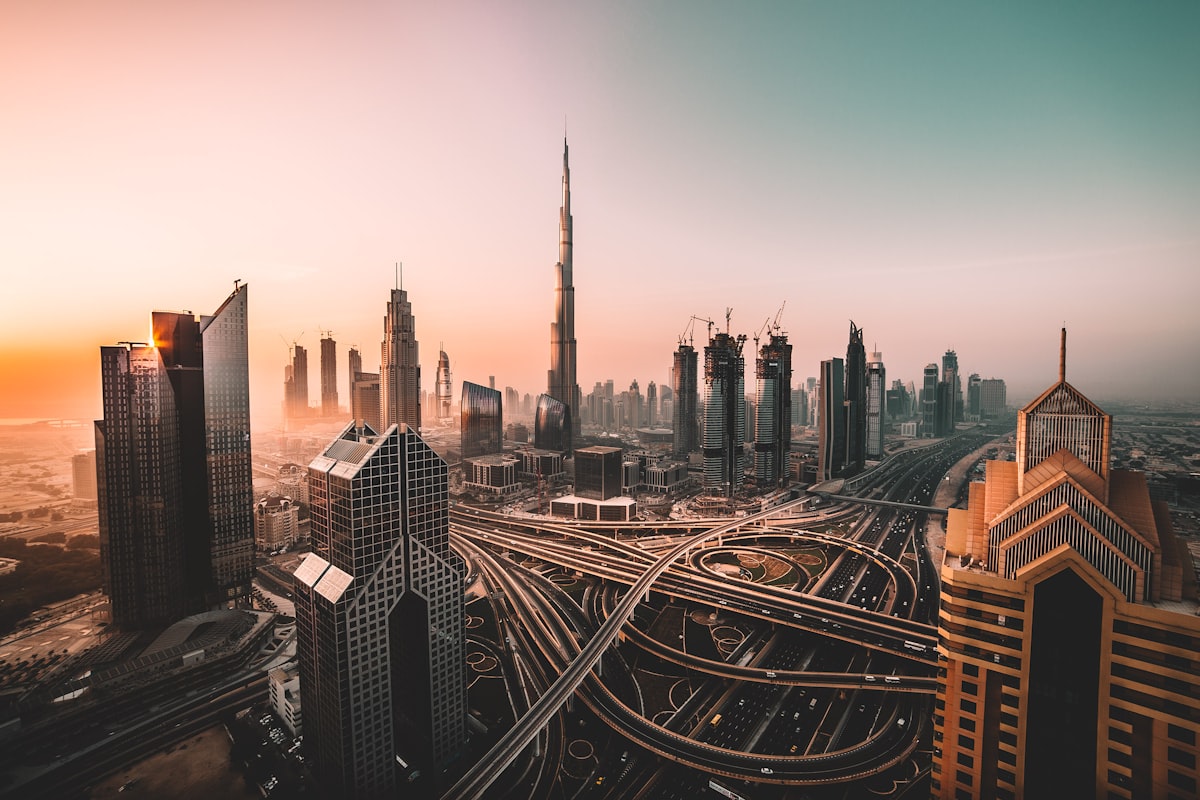
There is a moment during intermission at the Dubai Opera — usually during the more ambitious productions, the ones that draw the city's cultural establishment rather than its tourist constituency — when the auditorium's retractable glass walls slide open and the Mohammed bin Rashid Boulevard promenade extends into the performance space like a terrestrial extension of the stage. The Burj Khalifa, illuminated and impossibly vertical, occupies the background with the indifference of a monument that has long since ceased to be surprised by its own grandeur. The audience, champagne in hand, occupies a threshold between interior and exterior, between culture and commerce, between the city Dubai was and the city it is strenuously becoming. It is in this threshold that the Opera District reveals its true ambition: not merely to house performing arts, but to redefine the relationship between cultural infrastructure and ultra-luxury real estate in a city that has historically privileged the latter at the expense of the former.
The Dhow and the Auditorium
The Dubai Opera building, completed in 2016 by the Danish firm Atkins, takes the form of a traditional wooden dhow — the sailing vessel that sustained Gulf trade for centuries before oil rendered commerce maritime in a different sense. The metaphor is not subtle, but it is effective: the building's curved timber-clad hull rises from a landscaped plaza like a vessel beached by some cultural tide, its prow pointing toward the Creek — Dubai's historic waterway and the origin point of its mercantile identity. The architectural gesture connects the contemporary performing arts programme to a trading heritage that predates the UAE itself, and it does so with a visual boldness that ensures the building functions as a landmark even for those who never enter it.
Inside, the auditorium seats 2,000 in a configuration that can transform from a traditional proscenium theatre to a flat-floor concert hall to a banqueting space within 24 hours. This flexibility — enabled by a hydraulic platform system and retractable seating manufactured by the German firm Waagner-Biro — was a deliberate design choice that reflects Dubai's pragmatic approach to cultural infrastructure: a building that serves one function is a building that sits empty 60% of the time, and empty buildings in a city where land values exceed AED 50,000 per square metre represent an economic absurdity that no amount of cultural prestige can justify.
The Cultural Catalyst Theory
The Opera District was conceived not as a standalone cultural venue but as the centrepiece of a broader urban strategy that Dubai's Urban Planning Council calls "cultural catalysis" — the deliberate deployment of performing arts infrastructure to elevate the perceived value of surrounding real estate. The theory, borrowed from the Bilbao Guggenheim playbook but adapted to Gulf economics, is straightforward: a world-class cultural venue attracts a residential demographic that values intellectual and aesthetic engagement alongside the material comforts that Dubai has always provided. This demographic — older, wealthier, and more likely to establish permanent residency than the typical Dubai investor — commands higher per-square-metre pricing and generates lower tenant turnover, both of which increase long-term asset value for developers and landlords.
The evidence supports the theory. Since the Dubai Opera's opening, residential property values within a 500-metre radius have appreciated at approximately 14% compound annually — outperforming the broader Downtown Dubai market (11%) and the citywide average (8.5%). The premium is most pronounced in the buildings with direct sight lines to the Opera: the 80-storey Opera Grand tower, completed in 2020, achieves per-square-metre pricing that is 25-30% above comparable towers in Downtown without Opera views. Emaar's Forte tower, positioned directly adjacent to the Opera plaza, has recorded secondary-market transactions exceeding AED 7,500 per square foot — pricing that approaches the levels previously reserved for Burj Khalifa residences.
Il Primo: The Penthouse Proposition
No discussion of the Opera District's luxury market is complete without acknowledging Il Primo — the ultra-premium penthouse collection at the 72-storey Opera Grand, developed by Emaar as a direct response to the district's cultural repositioning. The three Il Primo penthouses, each occupying a full floor at the tower's apex, were designed by the Milanese studio Pagani Automobili Design (yes, the hypercar manufacturer's design division) with a brief that reportedly read: "Create the interior experience of a AED 100 million home at an altitude of 300 metres."
The results are excessive by any reasonable standard and precisely calibrated by the standard that governs this market segment. Materials include Calacatta marble from a single quarry in Carrara (ensuring veining consistency across all surfaces), hand-stitched leather wall panels using hides from the same Italian tannery that supplies Pagani's automotive interiors, and kitchen appliances by Molteni — not the fashion house but the Brescian manufacturer of professional cooking equipment, each range hand-assembled and priced at approximately AED 400,000. The penthouses' private terraces — each exceeding 200 square metres — offer 360-degree views that encompass the Burj Khalifa, the Arabian Gulf, the Opera plaza, and, on clear days, the Hajar Mountains 80 kilometres to the east.
Two of the three penthouses sold prior to completion, both to Gulf-based buyers, at prices that Emaar has not disclosed but that market sources place north of AED 150 million each. The third was retained by Emaar as a corporate hospitality asset — a decision that speaks volumes about the company's assessment of the unit's long-term appreciation trajectory: it is worth more as a permanent asset on the balance sheet than as a one-time revenue event.
The Boulevard Economy
The Mohammed bin Rashid Boulevard — the pedestrian promenade that connects the Dubai Opera to the Burj Khalifa via a 1.5-kilometre landscaped corridor — has evolved into the Opera District's commercial spine and one of the Gulf's most compelling luxury retail environments. Unlike the Mall of the Emirates or Dubai Mall, which operate on the enclosed-megastructure model of traditional Gulf retail, the Boulevard is an open-air experience: restaurant terraces, boutique frontages, and pop-up galleries that activate the streetscape from late afternoon through midnight.
The food and beverage offering on the Boulevard has matured beyond the generic international-hotel-restaurant formula that characterised Downtown's first decade. Recent arrivals include Trèsind Studio (a 22-seat modern Indian restaurant that holds a Michelin star and requires reservations six weeks in advance), LPM Franck (the third outpost of the Monaco-based Mediterranean restaurant, occupying a corner site with Opera views), and Reif Othman's eponymous Japanese-Emirati fusion restaurant, which has become the pre-opera dining destination for the city's cultural establishment. These are not restaurants that depend on tourist footfall; they are restaurants that depend on the repeat patronage of residents who have chosen to live in the Opera District specifically because it offers a cultural density that no other Dubai neighbourhood can match.
The Resident Composer Programme
In 2024, the Dubai Opera launched its Resident Composer Programme — a three-year initiative, funded by the Dubai Culture & Arts Authority, that commissions original works from composers of Arab heritage for premiere at the venue. The first commissioned work — "Wadi," a chamber opera by the Jordanian-American composer Layale Chaker that explored the acoustic archaeology of dry riverbeds — premiered to a sold-out house in January 2025 and was subsequently invited to the Salzburg Festival. The programme represents a significant evolution in the Opera's identity: from a receiving house that imports Western cultural product to a commissioning institution that generates original work with regional resonance.
For the Opera District's real estate market, the Resident Composer Programme's significance is less cultural than demographic. It signals to the UHNW audience that Dubai is not merely building cultural infrastructure but investing in cultural production — a distinction that matters to the educated, globally mobile buyer whose lifestyle preferences extend beyond golf courses and beach clubs. This buyer is already present in cities like London, Paris, and New York, where proximity to cultural production (the West End, the Opéra Garnier, Lincoln Center) commands measurable real estate premiums. The Opera District's bet is that the same dynamic can be cultivated in the Gulf — that a commissioning opera house in Dubai will exert the same gravitational pull on UHNW residential demand that La Scala exerts in Milan or the Sydney Opera House exerts in Circular Quay.
The Vertical Village
The Opera District's residential architecture is notable for its density and verticality. Within a 500-metre radius of the Opera building, there are currently 14 towers exceeding 40 storeys, with a combined residential inventory of approximately 8,500 units. This density would be problematic in most urban contexts, but the district's master plan — which mandates minimum tower spacing, ground-level setbacks, and podium-level pedestrian connectivity — creates a street-level experience that is considerably more humane than the raw numbers might suggest.
The most sophisticated residential offering within the district is arguably not the most expensive. The Address Residences Dubai Opera — a 65-storey tower managed by Emaar Hospitality under the Address brand — offers a hybrid model that blends hotel services with residential autonomy: owners receive the security, concierge, and maintenance infrastructure of a five-star hotel while retaining the privacy and spatial customisation of a private residence. Units in the tower range from one-bedroom apartments at AED 2.5 million to three-bedroom penthouses at AED 25 million, and occupancy rates exceed 90% — a figure that confirms the demand hypothesis underlying the district's cultural catalysis strategy.
The Opera District is, in essence, Dubai's answer to a question that the city has been asking since its first boom cycle: can a place built on commerce cultivate the cultural gravity of cities built on centuries of artistic tradition? The honest answer, today, is "not yet." The district lacks the density of independent galleries, the ecosystem of working artists, and the weight of cultural memory that define mature cultural quarters in older cities. But it has something that those cities do not: a willingness to invest sovereign-scale capital in the proposition that culture and commerce are not merely compatible but mutually reinforcing. The dhow-shaped building on the boulevard is both a performing arts venue and a thesis statement. The Opera District is betting that, given enough time, enough programming, and enough penthouse sales, the thesis will prove correct.
Published by Latitudes Media · Dubai Latitudes