Al Barari: The Botanical Sanctuary Where Dubai Discovered Silence
March 15, 2026 · 11 min read
In a city defined by verticality — the world's tallest tower, the world's highest restaurant, the world's most elevated infinity pool — Al Barari commits to a radical proposition: staying close to the ground. This 14.2 million-square-foot botanical estate, tucked into the intersection of Sheikh Mohammed Bin Zayed Road and Al Ain Road, is Dubai's most counterintuitive luxury address. There are no towers. No glass facades competing for skyline supremacy. Instead, there are streams. Waterfalls. Over 500,000 plants from six continents. And a silence so profound that residents report hearing birdsong — an almost surreal phenomenon in a city of perpetual construction.
The Anti-Dubai That Became Peak Dubai
Al Barari was conceived by the Zaal family, who purchased the land in 2005 with a vision that seemed almost perversely contrarian: build the least Dubai-like community possible within Dubai's city limits. Where other developers were racing upward, the Zaals went lateral. Where others poured concrete, they planted. The project's first three years were dedicated entirely to landscaping — creating the botanical infrastructure before a single villa foundation was laid. By the time the first residents moved in, the gardens were already mature, the streams already flowing, the ecosystem already alive.
This patience has become Al Barari's ultimate luxury. In 2026, the estate's gardens have achieved a density and maturity that no new development can replicate. The canopy cover creates microclimates measurably cooler than surrounding areas — up to 8°C lower during peak summer — a functional luxury that transcends aesthetics. Residents speak of "the transition": the moment you pass through Al Barari's gates and the temperature drops, the noise disappears, and the desert metropolis evaporates behind a curtain of tropical green.
The Villas: Where Architecture Dissolves Into Landscape
Al Barari's residential inventory comprises approximately 217 villas across five clusters: The Residences, The Nest, Ashjar, The Reserve, and the newly completed Seventh Heaven — a collection of 14 ultra-premium estates that represent the pinnacle of the development. The Seventh Heaven villas range from 15,000 to 28,000 square feet of built-up area, each positioned on plots exceeding 30,000 square feet, with prices beginning at AED 35 million and the most exceptional properties trading above AED 65 million.
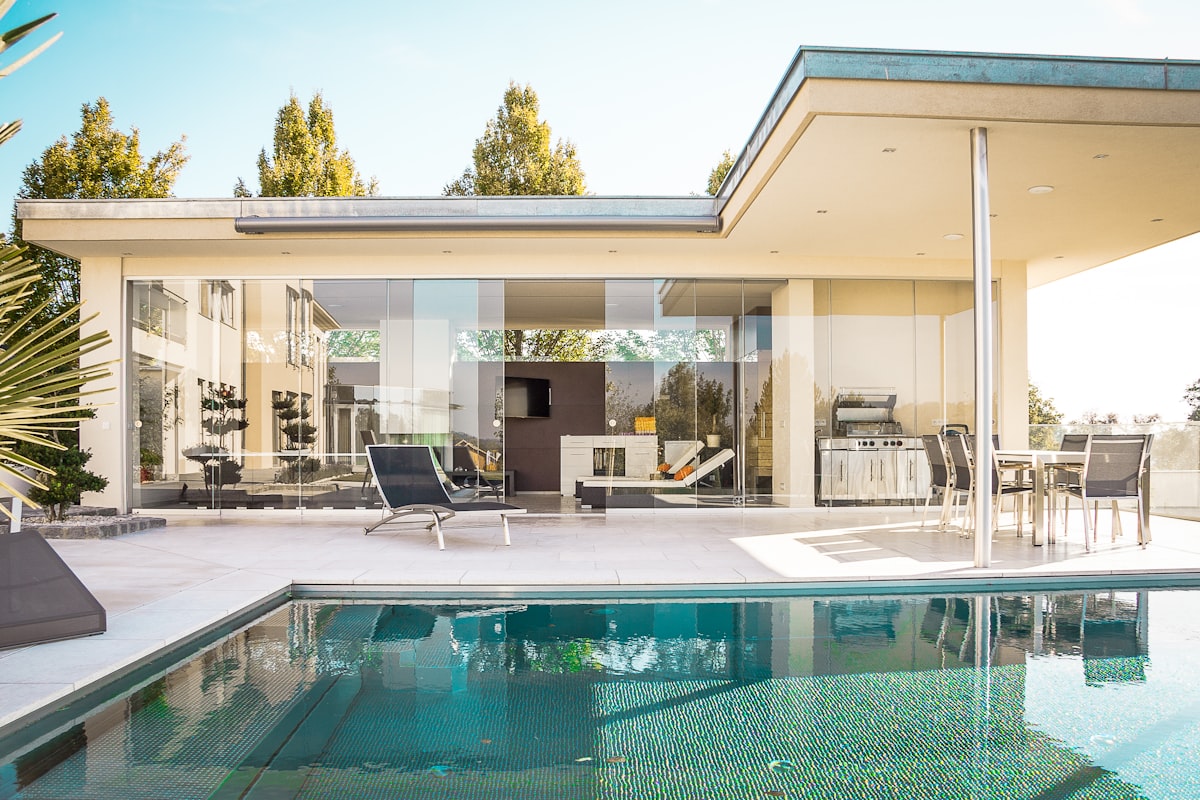
What distinguishes these homes architecturally is their porosity. Floor-to-ceiling glass walls retract entirely, erasing the boundary between interior and garden. Infinity pools flow into streams that connect to the estate's central water system. Master suites open directly onto private courtyards planted with frangipani and bougainvillea. The architecture doesn't compete with the landscape — it surrenders to it. Zaha Hadid's original design language influenced the curvilinear forms, but the dominant aesthetic force is botanical: every architectural decision is subordinate to the garden.
The Heart House: Gastronomy in the Green
At the centre of Al Barari sits The Heart of Europe restaurant — a Michelin-starred establishment that has become one of Dubai's most coveted reservations. But unlike the city's other fine dining destinations, perched atop towers or embedded in marble-clad hotel lobbies, The Heart sits among the gardens. Tables overlook streams where koi drift between water lilies. The tasting menu draws from the estate's own organic gardens, where the chef harvests herbs each morning along the same paths that residents walk their dogs.
The culinary programme extends beyond the restaurant. Al Barari operates a 10,000-square-foot organic farm within the estate, supplying residents with seasonal produce through a weekly basket programme. Cooking classes take place in greenhouse kitchens. The estate's apiary produces honey served exclusively within the community. This is not performative sustainability — it is a genuine alternative to the imported, air-conditioned luxury that defines most of Dubai's premium residential experience.
The Wellness Ecosystem
Body Language, Al Barari's spa and wellness centre, occupies a standalone pavilion surrounded by therapeutic gardens. The facility offers Ayurvedic treatments, cryotherapy, and a hydrotherapy circuit that moves between heated mineral pools, cold plunges, and an outdoor relaxation area where steam rises into the canopy at dawn. But the true wellness asset is the estate itself: 3.2 kilometres of garden trails for running and walking, yoga decks positioned among the water features, and an ambient sound environment dominated by moving water and birdsong rather than traffic and construction.
In 2025, Al Barari introduced a longevity programme in partnership with a Swiss medical institute, offering residents personalised health assessments, genetic testing, and ongoing monitoring — all conducted within the estate's medical pavilion. The programme reflects a broader shift in Dubai's ultra-luxury market: the most discerning buyers are no longer optimising for status symbols but for quality of life, measured in years gained rather than square footage acquired.
Investment Dynamics
Al Barari's resale market tells a compelling story. Properties that traded at AED 12 million in 2020 now command AED 28–35 million — a growth trajectory that outpaces even Palm Jumeirah's signature villas. But the most revealing metric is turnover: Al Barari has one of the lowest resale rates in Dubai's luxury market, with an estimated annual turnover below 3%. Residents, once they adjust to the silence and the green, simply don't leave.
For investors, this illiquidity is both a risk and a signal. Al Barari is not a flip — it is a hold. The estate's finite inventory (no new plots can be created), maturing landscape (irreplaceable), and shifting buyer preferences toward wellness and nature suggest sustained appreciation. In a market where new ultra-luxury supply seems infinite — Dubai added 4,200 premium units in 2025 alone — Al Barari's scarcity is its ultimate moat.
The botanical sanctuary that once seemed like Dubai's most eccentric bet has become, quietly and without fanfare, its most intelligent one. In a city of superlatives, Al Barari's greatest achievement may be the simplest: it makes you forget you're in Dubai at all.